
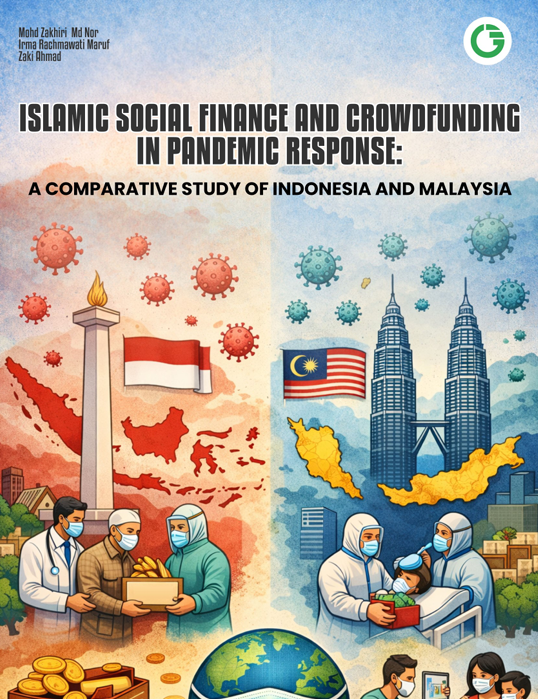
Islamic Social Finance and Crowdfunding in Pandemic Response: A Comparative Study of Indonesia and Malaysia
Synopsis
Islamic Social Finance and Crowdfunding in Pandemic Response: A Comparative Study of Indonesia and Malaysia
The COVID-19 pandemic not only triggered a global health crisis but also starkly exposed the vulnerabilities of conventional financial systems in responding to urgent and widespread social needs. Amid the limited reach of formal relief systems, digital crowdfunding platforms proved capable of serving as fast, inclusive, and responsive resource mobilisation channels. This book offers an in-depth examination of that phenomenon: how social-based crowdfunding played a role in mitigating the impacts of COVID-19, particularly in the two countries with the largest Muslim populations in Southeast Asia — Indonesia and Malaysia — and how such practices can be evaluated within the framework of Islamic social finance and applicable legal regulation.
By integrating a robust theoretical framework with a comparative analysis of two jurisdictions, this book positions crowdfunding not merely as a fundraising instrument but as a socio-technical governance system that mediates trust, ethics, and law. The authors' central argument is that the effectiveness and legitimacy of crowdfunding during crises depend heavily on governance quality — encompassing platform transparency, Shariah compliance, legal protection for donors, and accountability in the use of funds.
The book is built upon three principal theoretical pillars drawn from the crowdfunding literature: agency theory, to explain the risks of information asymmetry between fundraisers and donors; signaling theory, to analyse how platforms and campaign organisers build trust through disclosure and verification; and social capital theory, to understand how social networks, community identity, and religious solidarity drive public participation. Within the Islamic context, these three theories are enriched by the normative framework of Maqasid al-Shariah — the higher objectives of Islamic law encompassing the protection of life (hifz al-nafs), wealth (hifz al-mal), intellect, lineage, and religion — as a benchmark for assessing whether crowdfunding genuinely contributes to societal welfare.
Islamic social finance instruments such as zakat, waqf, infaq, and sadaqah receive particular attention in this book. The authors examine how these instruments can be integrated with digital crowdfunding mechanisms to move beyond conventional, short-lived charitable models toward more sustainable social financing arrangements. Of special note, waqf-based crowdfunding is discussed as a promising innovation: grounded in the principle of perpetuity of principal and amanah-based stewardship, crowdfunding-waqf has the potential to transform episodic donations into enduring social capital that continues to generate long-term community benefit. Empirical case analysis is presented through an examination of real campaigns conducted in both countries during the pandemic — ranging from fundraising for personal protective equipment for healthcare workers, food assistance for low-income families, to emergency support for micro-entrepreneurs. Campaign data are used to identify success patterns, governance gaps, and platform challenges — including fraud risks, insufficient verification, and limited impact reporting. These findings are then analysed through two parallel lenses: a legal perspective (encompassing the regulatory frameworks of the Securities Commission Malaysia, Indonesia's Otoritas Jasa Keuangan, and the AAOIFI Governance Standard GS-14 on Islamic crowdfunding governance) and a Shariah perspective (covering contract permissibility, fiduciary obligations, and alignment with Maqasid).
On the regulatory front, the book documents significant developments in both jurisdictions. Malaysia has strengthened its legal framework through the Guidelines on Recognized Markets and — in September 2025 — the Guidelines on Social Exchange Platforms, which explicitly require reporting and disclosure obligations for non-profit fundraising platforms. Indonesia, through OJK, has updated its regulatory regime from POJK 37/2018 to POJK 57/POJK.04/2020, broadening the scope and reinforcing protections for users of securities-based crowdfunding. This comparative study demonstrates that regulation is not merely a constraint but an infrastructure of trust that determines the quality and sustainability of the crowdfunding ecosystem.
The book concludes with strategic conclusions and a forward-looking research agenda. The authors highlight the urgency of developing blockchain-based transparency mechanisms for waqf fund management and long-horizon crowdfunding, harnessing artificial intelligence (AI) for fraud detection and compliance monitoring, and conducting further studies on donor behavioural shifts under different transparency regimes. Overall, the book argues that the most effective and ethically sound crowdfunding is that which combines the moral energy of social solidarity with robust governance, transparent reporting, and regulatory support enabling Muslim communities in Indonesia and Malaysia to mobilise resources rapidly during crises while building lasting trust and measurable, sustainable welfare outcomes.
Published
June 4, 2026
Categories
Copyright (c) 2026 Greenbook Publishing
Details about the available publication format: Preview
Preview











 This work is licensed under a